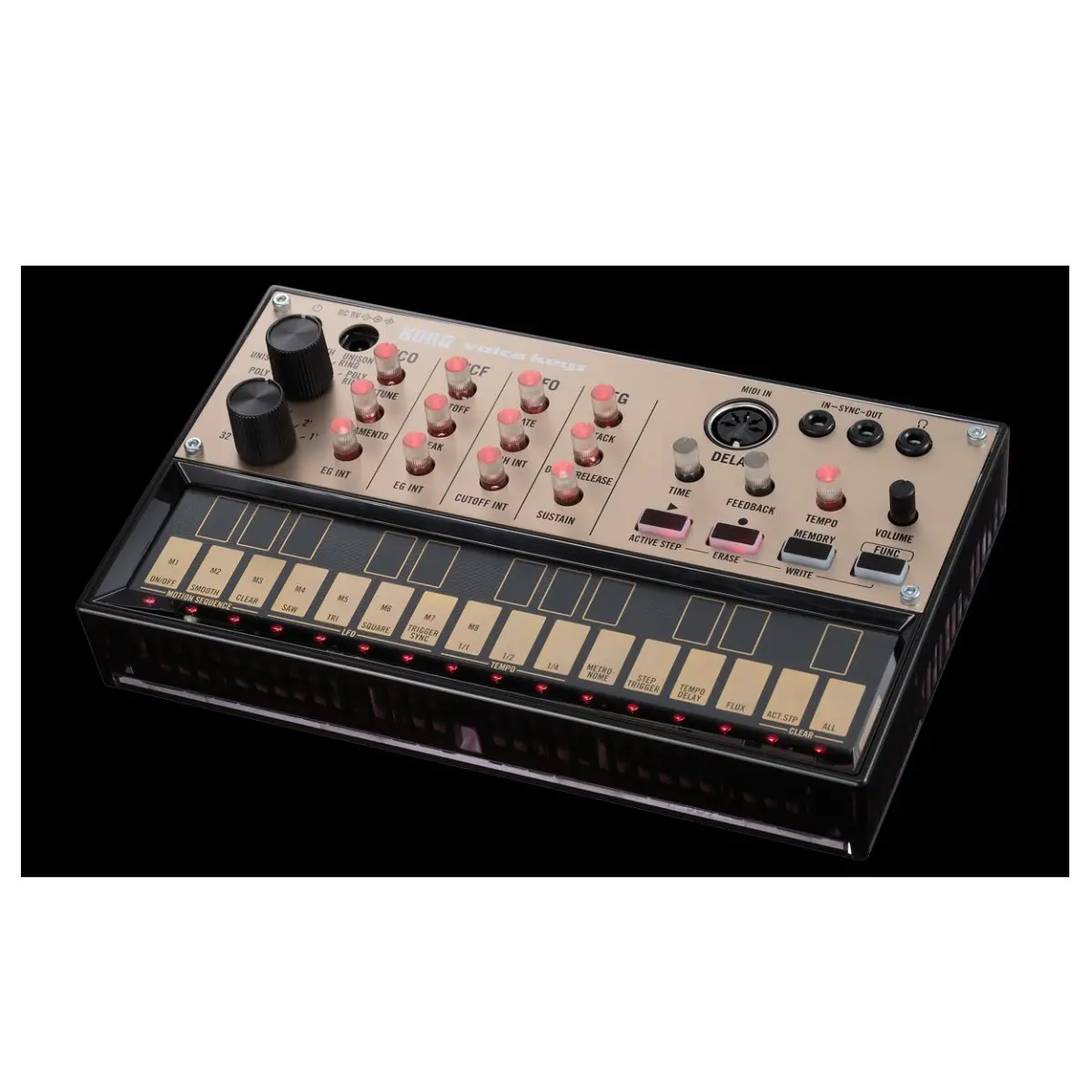
Korg – NAUTILUS 88 Music Workstation

$4,131.00

-

The most dazzling and expansive collection of sounds ever put into a Korg synthesizer

NAUTILUS pushes the boundaries of what a performance synth and workstation is capable of. With the power of nine engines to drive a new approach to sounds, plentiful sampling, audio recording, effects, and processing power, there is simply no other synth that delivers more to explore sonically, with the workflow to get you there faster than ever. Korg spent years refining all our digital, analog, processing, and hardware technologies and delivering them in a way that helps the musician connect with their instrument. The result is the incredibly powerful, one-of-a-kind NAUTILUS.

Brand

Out of stock. Expect a longer delivery time.

SKU: KO-NAUTILUS88 Category: Tag:
Description

FEATURES

  • Nine different sound engines offer massive expressive power
  • New sounds offered over three broad categories
  • The DYNAMICS knob makes delicate expression possible
  • Make intuitive changes to sounds with the Realtime knobs
  • A user interface designed for easy operation
  • Convenient arpeggiator and drum track functions
  • Color TouchView Display
  • Set list mode that demonstrates its power in live performances
  • Open Sampling System
  • 16-Track MIDI Sequencer / 16-Track Audio Recorder
  • 16 Onboard Effect Processors
  • USB/MIDI Host Ports Accommodate MIDI Control Surfaces
  • Smooth sound transitions that eliminate dropouts when changing sounds, regardless of the mode you’re in
  • 88-key model with piano touch, 73-key model with light touch and 61-key model available
  • Stand-alone and Plug-in NATULUS Editing Software


Nine different sound engines offer massive expressive power

The NAUTILUS features nine dedicated sound engines to realistically reproduce sounds such as pianos, electric pianos, organs and more.

To start, the enhanced SGX-2 piano sound generator offers delicate expressiveness to capture all the nuances of the acoustic piano, and NAUTILUS features the most piano libraries ever put into one product; with 12-step velocity-switched sound, string resonance and more. The EP-1 electric piano sound generator realistically reproduces seven different famous electric piano sounds. The CX-3 engine – the heart of our sought-after CX-3 reissue -covers the distinct sound of classic tonewheel organs. Add to that MOD-7 VPM/FM synthesis, the PolysixEX and MS-20EX for analog modeling, and the STR-1 for physical modeling, and you have essentially an engine for any type of sound you’re looking to get. Used together in Program or Combination mode, these distinctive engines create completely new timbres.

New sounds offered over three broad categories

The approach to the included sound on NAUTILUS, started with Korg setting aside our preconceptions of what sound should be like on a conventional music workstation, and instead focused on pushing the boundaries of sampling and programming to create a brand-new classifications of programs that we divide into three groups:

“Unique” sounds:

The NAUTILUS brings you distinctive sounds including phrase loops, prepared pianos, found percussion and more. Many seldom heard-of musical instruments found in different regions around the world can be difficult to play, but distinctive phrases played on these instruments are featured on the NAUTILUS. Use these phrases as-is in your songs—let your imagination be your guide. The NAUTILUS features sounds that were sampled for the first time just for this instrument, including prepared piano sounds created by placing different objects between piano strings and recording samples, or “found percussion” sounds made by turning ordinary items into instruments to be struck. Not only do these novel and mysterious sounds provide an unexpected flavor to your songs, they offer broad possibilities for sound effects used in film and TV music as well.

“Current” sounds:

The NAUTILUS also offers the freshest sounds that blend in well with today’s music scene, including synths, drum kits, special effects and more. For synths, be sure to check out the EDM, electro and chiptune sounds for starters. Also, the NAUTILUS features more than 50 kinds of drum kits—sounds that most strongly reflect the changes in music over time. The special effect sounds offer useful material like drums added to dance music to create beats—sounds that you can put to use right away.

Standard sounds:

We’ve brought together all of the most important sounds a workstation needs including piano, electric piano, guitar, bass guitar and more, covering all genres. For the newly sampled piano sound, we’ve also recorded the lovely sonic ambience of the studio, and you can mix the piano and ambience sound as you like with the new ambience sound. A new electric piano model with a characteristic thick sound has been added, which works great for funky playing styles. We’ve also added many phrases that let you play back actual performances of guitar and bass parts that keyboardists will find useful.

The DYNAMICS knob makes delicate expression possible

With the DYNAMICS knob, you can instantly control the changes in volume and tone in response to how hard you play the keyboard (velocity); and you can customize this knob in real time to match the keyboard playing feel required for each style and song. Even when playing the same sound, you can turn this knob to get the feeling of playing a completely different sound. By finding just the right setting for your playing style, you’ll uncover even more of the possibilities that the NAUTILUS offers.

When you activate the DYNAMICS knob and turn it to the left, the keyboard responds more softly to your playing, giving you a wide range of dynamics. This allows for delicate, expressive playing when accompanying a piano solo or vocals, which directly reflects the dynamics of your performance. On the other hand, turning the knob to the right gives a stronger, more flat dynamic response. This brings out the sound when you’re playing in a band or ensemble, which works best when performing with a more even feel.

Make intuitive changes to sounds with the Realtime knobs

The six RT (real-time) knobs at the top left of the panel give you direct control over changes to the PROG and COMBI sounds. A variety of functions are assigned to each knob that lets you enjoy making changes to sounds, such as the filter cutoff and effect depth, the gate time, tempo and swing of the arpeggiator or drum track, the type of snare drum and more. In COMBI mode, you can group timbres and control their levels with the knobs. Further, you can press these knobs into the panel to lock them in place, preventing them from being accidentally changed while you’re playing. For instance, you could use this to enable only the knobs you often use onstage and push the ones in that you do not need.

A user interface designed for easy operation

For the NAUTILUS, we have completely rethought the user interface, considering that panel controls tend to become denser as more functions are added. The interface of the NAUTILUS lets users find just the things they’re looking for once they understand the principles.

The MODE button lets you see what you’ve selected in each mode on a single screen, from PROG and COMBI to the set list, sampling, sequence and global modes. Each mode has tabs for each function, and the PAGE buttons offer more detailed editing with consistent operations. With the user-friendly navigation of the NAUTILUS, you can press the MODE button at any time to return to the start if you get lost. A dark mode is available for the display, using black as the primary color to reduce eye fatigue.

Six quick access buttons are also available as shortcut buttons. The NAUTILUS further offers four templates as a continuation of the previous user-friendly features, which can be used to select modes like PROG and COMBI, as transport buttons for sequencer playback and recording and so on. You can also select your own settings as you like. What’s more, you can freely assign functions you frequently use and save them in one of four sets.

Convenient arpeggiator and drum track functions

Four scenes of arpeggio patterns and drum track sets are made available that perfectly match each PROG and COMBI preset sound. These are useful for switching between scenes while they’re played, for use when improvising during performance, or for expanding your vision when composing music starting from a sound.

Color TouchView Display

The nerve center of the NAUTILUS is KORG’s enormous eight-inch (800 x 480 pixel) WVGA color TouchView display.

In addition to simply selecting a sound or choosing a parameter with the touch of a finger, the enhanced Touch-Drag ability allows more detailed control of parameter values. Interactive instruments and panel graphics provide the ability to do everything from adjusting the lid of a grand piano to connecting patch cable on a semi-modular synthesizer model.

The TouchView display also hosts a convenient new Search Function, allowing you to search for (and preview) sounds based on their titles.

Set list mode that demonstrates its power in live performances

NAUTILUS can organize all of the resources you need to get through a song—or a set—using the Set List mode. Using the Set List mode, the TouchView display can host 16 color-coded touch-screen buttons; each one can instantly call up the appropriate Preset, Combination, or Sequence—regardless of mode!

You can also select different button colors, such as when you want to change the colors within a song while playing live. This is a powerful feature for situations that require quick and accurate control. The Set List mode even adds a nine-band graphic EQ, allowing the overall tone to be tweaked to match the venue.

Open Sampling System

Using KORG’s Open Sampling System, NAUTILUS can quickly sample an external audio source, regardless of whether NAUTILUS is in the Program, Combination, or Sequencer modes. The Open Sampling Mode can even resample the performance of the NAUTILUS itself. The user sample bank, which extends the convenience of the EXs sample library to user samples, allows custom samples to be loaded and played, taking advantage of the gigantic SSD capacity.

AIFF, WAV, SoundFont 2.0, and AKAI S1000/3000 format samples can be loaded into memory via USB memory. Additionally, you can use a USB Ethernet adapter to exchange large amounts of sample data with your computer at high speed. Instruments or samples that you’ve previously created on your PC can be used to construct a music production setup based on just the NAUTILUS itself.

16-Track MIDI Sequencer / 16-Track Audio Recorder

NAUTILUS features a sequencer/recording section that offers both 16 MIDI tracks plus 16 audio tracks; a great resource for putting together a dazzling performance or a brilliant production. MIDI sequencing makes it easy to capture ideas, inspiration, and pro-quality phrases using the Drum Track, or RPPR (Realtime Pattern Play/Recording) functions.

The 16-track audio recorder simultaneously captures up to four tracks of 16-bit/24-bit uncompressed data at a sampling rate of 48 kHz. Play along with recorded tracks, add effects, and then resample the NAUTILUS itself and place the resampled WAV files directly in a track. When polishing your tracks, feel free to use mixer automation and editing functions such as copy, paste, and normalize to get the results you want.

16 Onboard Effect Processors

NAUTILUS provides 16 internal effects to add impact to your sonic creations. Each of the 12 Insert effects can be applied to individual or multiple timbres in a combination, or to individual or multiple tracks of the sequencer. In addition, two Master effects can be applied to sends 1/2, and two Total effects can be applied to all tracks at the final stage of the sound.

A separate three-band EQ is provided for every timbre, for every sequencer track, and for every audio track for adjusting subtle tonal balances or for creatively modifying the overall sound.

USB / MIDI Host Ports Accommodate MIDI Control Surfaces

Any class-compliant USB-MIDI controller can be connected directly to the NAUTILUS. Assign functions to a Korg USB MIDI controller with pads (nanoPAD, nanoPAD2, padKONTROL) to play drum parts.

Smooth sound transitions that eliminate dropouts when changing sounds, regardless of the mode you’re in

When you switch program sounds during a performance to get ready for the next section, or when you switch from Program mode to Combi mode, the sound that’s currently being output is always given priority and its effects are maintained during the program change, ensuring a seamless transition with no dropouts. This function has also earned extremely high praise from pro musicians.

88-key model with piano touch, 73-key model with light touch and 61-key model available

The keyboard on the 88-key model of the NAUTILUS uses a four-stage real weighted hammer action made in Japan, called the RH-3. This action is heavier on the lower notes and lighter on the higher notes for superb playability. The 73-key model features a much-requested light-touch synth keyboard from C to C, as with the 61-key model. This key action lets you play organ parts with plenty of glissandos, as well as synth solos that take advantage of the keyboard’s wide range.

The 88-key model is fitted with luxurious wooden side panels, and the 73-key and 61-key models a completely new design with impressive curves that rise from the bottom of the unit to the sides, patterned after the NAUTILUS’ namesakes: the Nautilus submarine and the cephalopod mollusk. All of these elements make the NAUTILUS a distinctive instrument onstage as well, brimming with personality.

Stand-alone and Plug-in NATULUS Editing Software

The NAUTILUS Editor and NAUTILUS Plug-In Editor allow you to edit your NAUTILUS from your computer while viewing large numbers of parameters simultaneously, or to use NAUTILUS in your DAW as if it were a software synthesizer. You can download the latest version of the NAUTILUS sound editor from the Korg website.

Free bundle of music software

The NAUTILUS comes with a diverse variety of music software from Izotope including “Ozone Elements” which lets you not only create songs but also master them using AI, “Skoove” which will help you improve your keyboard playing skills, as well as software synths from KORG and other brands.

In other words, the moment you get your hands on this synthesizer you’ll have a variety of tools to help you take your music to the next level.

About Korg
Logo Korg

About Korg

Korg Inc., founded as Keio Electronic Laboratories, is a Japanese multinational corporation that manufactures electronic musical instruments, audio processors and guitar pedals, recording equipment, and electronic tuners. Under the Vox brand name, they also manufacture guitar amplifiers and electric guitars.

Shipping

FREE SHIPPING ON MOST PRODUCTS OVER $100

We offer free shipping on most products of $ 100.00 and over with a dimensional weight under 35 pounds.

For orders over $100 with no weight overload or fuel overload, after checking the best delivery options, we could refund you part of shipping fees.

Free shipping is not valid for remote regions such as Nunavut, Yukon, Northwest Territories and the non-metropolitan regions and all other areas driven by our courier. (Purolator / FedEx / UPS). All items will be shipped uninsured via Purolator or Canada Post. Insurance can be added, please just call us to know the details.  It is also possible to deliver order by bus for Quebec resident. Please contact us to get more information about this option.

In store pick up

  • To pick up your order in store, please write it down in the additional information. Specify the store of your choice. (Laval or Montreal)
  • When your order is ready, we will notify you.
  • You can then come to the selected store to pick up your order by presenting the credit card used for the transaction and a valid Photo ID card showing the billing address that appears on your order.
Specifications
System, Keyboard
SystemNAUTILUS System Version 1.0
Keyboard88 key: RH3 (Real Weighted Hammer Action 3), A - C
73 key: Natural Touch Semi Weighted, C - C
61 key: Natural Touch Semi Weighted, C – C
Velocity sensitive is supported, after touch is not supported.
Tone Generator
Synthesis Types9
SGX-2: Premium Piano (Acoustic Piano)
EP-1: MDS Electric Piano (Electric Piano)
HD-1: High Definition Synthesizer (PCM)
AL-1: Analog Synthesizer (Analog Modeling)
CX-3: Tonewheel Organ (Tonewheel Organ Modeling)
STR-1: Plucked String (Physical Modeling)
MOD-7: Waveshaping VPM Synthesizer (VPM Synthesis)
MS-20EX: Component Modeling Technology (Analog Modeling)
PolysixEX: Component Modeling Technology (CMT Analog Modeling)
Maximum Polyphony*1*2SGX-2: 100 voices*3
EP-1: 104 voices
HD-1: 140 voices
AL-1: 80 voices
CX-3: 200 voices
STR-1: 40 voices
MOD-7: 52 voices
MS-20EX: 40 voices
PolysixEX: 180 voices
1: In rare cases, when a large number of processor-intensive effects are active simultaneously (for instance, more than 14 O-Verbs), polyphony may be slightly reduced.
*2: A portion of the multicore processor in NAUTILUS is devoted to generating voices, and a separate portion is devoted to generating effects. NAUTILUS dynamically allocates the voice processing power between the engines as necessary. The quoted maximum numbers of voices apply when 100% of the voice processing power is devoted to a single engine.
*3: 100 dual-stereo notes (equivalent to 400 mono voices)
Preset PCMRAM 496 MB / DISK 2.3G (ROM 1,771 Multisamples, 3,955 Drumsamples)
Build-in Expansion PCM Libraries
General
Disk ModeLoad, save, utility, data filer function (save/load MIDI System Exclusive data), CD-R/RW (UDF format read/write), ISO9660 Level 1.
ControllersJoystick, Switches 1 & 2
Arpeggiator Control: On/Off, Latch, Gate, Velocity, Length, Swing, Tempo
DRUM TRACK: On/Off, Swing, Drum SD, Tempo
DisplayTouchView graphical user interface, 7 inch color TFT, WVGA (800 x 480 dots), adjustable brightness
Principal SpecificationsFrequency Response
20Hz-22kHz, +/-1.0dB, 10k Ω load
THD+N
20Hz-22kHz, 0.01%, 10k Ω load (typical)
S/N
95dB (typical)
Dynamic Range
95dB (typical)
Crosstalk
95dB, at 1kHz (typical)
Outputs
L/MONO, R, Individual 1-41/4” TRS Balanced
Output Impedance: 350 Ω Stereo; 175 Ω Mono (L/MONO Only),
Nominal Level: +4.0 dBu,
Maximum Level: +16.0 dBu (when load impedance is 600 Ω or greater)
MAIN VOLUME slider controls only AUDIO OUTPUT (MAIN) L/MONO and R
Headphones1/4” stereo phone jack
Output impedance: 33 Ω,
Maximum Level: 60+60 mW (when load impedance is 33 Ω),
MAIN VOLUME knob (link with AUDIO OUTPUT (MAIN))
USB-B24-bit, Sample Rate: 48 kHz, 2 channels
(Digital output of the same signals as AUDIO OUTPUT (MAIN) L/MONO and R)
Inputs
Audio Inputs 1 and 21/4” TRS Balanced
Input Impedance: 10 kΩ
Nominal Level: LINE +4 dBu
Maximum Level: LINE +16 dBu
Nominal Level: MIC –22 dBu
Maximum Level: MIC -10 dBu
Source Impedance: 600 Ω
USB-B24-bit, Sample Rate: 48 kHz, 2 channels
Control InputsDamper pedal (half damper supported)
Assignable switch, Assignable pedal
MIDIIn, Out, Thru
USBUSB A (TYPE A)
For connection to external USB devices (QWERTY keyboards, MIDI controllers, ethernet adaptors, and storage)
USB B (TYPE B)
MIDI/audio interface, MIDI: 1 (16 channel) input / 1 (16 channel) output, Audio: 2 channel input / 2 channel output
*2 USB high-speed ports (supports 480Mbps)
Disk Drives60 GB SSD (2.5”)
Power SupplyAC power supply terminal, Power switch
Dimensions: (W x D x H)88 key: 1,437 x 387 x 139 mm / 56.57” x 15.24” x 5.47”
73 key: 1,227 x 386 x 116 mm / 48.31” x 15.20” x 4.57”
61 key: 1,062 x 386 x 116 mm / 41.81” x 15.20” x 4.57”
Weight88 key: 23.1 kg / 50.93 lbs.
73 key: 14.6 kg / 32.19 lbs.
61 key: 13.0 kg / 28.66 lbs.
Power Consumption40 W
AccessoriesAC cord, Quick Start Guide
OptionXVP-20: Expression/Volume Pedal
EXP-2: Foot Controller
DS-1H: Damper Pedal
PS-1: Pedal Switch
PS-3: Pedal Switch
Nine Engines

Nine Synthesizer Engines, United in One Instrument

NAUTILUS harnesses nine distinct synthesizer/sound engines into a single, integrated musical instrument. Dynamic voice allocation and new technologies allow all sound engines to smoothly share a stable, enhanced hardware platform. The results are nothing less than spectacular.

SGX-2
Premium Piano

This sound generator lets you perform with the sounds of famed grand pianos such as the German piano, on which the ambience sounds can be freely modified; or the Italian grand piano, whose sound is growing rapidly in popularity over recent years. These pianos offers delicate expressiveness to capture every last nuance of the acoustic piano, with 12-step velocity-switched sound, string resonance and more.

*String resonance
With the damper pedal depressed, all of the piano strings are free to resonate. When any key is played on the piano, other strings that are pitch-related to the original key may begin to vibrate via sympathetic resonance. The SGX-2 accurately captures and recreates this sympathetic string resonance, adding an additional level of detail to the grand piano sound.
* String resonance overtones can be viewed in the string length edit screen.

EP-1
MDS Electric Piano

This dedicated electric piano sound generator realistically reproduces seven different famous electric piano sounds, with the addition of an earlier model featuring a characteristic distortion. The MDS (Multi-Dimensional Synthesis) technology eliminates the transitions between velocity-switched samples, and does away with the unnatural behavior of looped samples. Smoothly responding to the nuances of the player's touch, yet allowing your performance to reach an energetic climax, this modelled engine features an astounding dynamic range that exceeds what one might expect from digital sound generation.

For each of the seven different models, different amps, cabinets, speakers, and standard vintage effects are realistically simulated. From the samples to the touch and the effects, all aspects affecting the sound are coordinated into a single package, making this the ultimate electric piano.

CX-3
Tonewheel Organ

Tonewheel organ sound engine

The original KORG CX-3 combo organ went on sale in 1980. Loved by musicians around the world, this classic organ reappeared in 2000 as a new product with the same name, but using the latest technology. In NAUTILUS, the CX-3 engine precisely models this classic tonewheel instrument. Proprietary KORG technology has been used to perfectly reproduce the vacuum tube amp, and effects such as Vibrato/Chorus. Special attention was given to the rotary speaker effect, which lets you choose from seven types, as well as use the NAUTILUS' joystick in the X-axis to control the speed. Even the instability, fold-back, leakage, and noise of the tonewheels have been obsessively analyzed and recreated. The organ sounds heard in legendary performances—some recreated here by the original artists—are now yours for the playing. Experience these classic organ sounds, reborn for the present day.

HD-1
High Definition Synthesizer

PCM sound engine

HD stands for “High Definition” indicating the HD-1’s superior sound, starting with KORG’s proprietary low-aliasing sample playback oscillators, full-bandwidth multimode resonant filters, and extraordinarily fast & smooth envelopes and LFOs. The HD-1 is the most powerful PCM sound engine in KORG’s history, into which KORG has poured all the PCM know-how accumulated since the M1. All of KORG's acclaimed PCM sounds are painstakingly created by specialized technicians. Data that was reluctantly omitted from previous models due to limited memory has now been called back into service on the NAUTILUS. The amount of waveform memory alone might rival a PC-based sound engine. Yet the real difference is in the completely different level of quality and finish that is obvious when you play these sounds as instruments on the NAUTILUS. The finest technicians, working on the finest platform, and aiming at the finest quality: that's the HD-1.

MS-20EX
Legacy Analog Collection

Analog modeling sound engine

Packed with cutting-edge technology, NAUTILUS nonetheless has respect for the classics. The KORG MS-20 first appeared in 1978 and quickly captivated many synth fans with its rich personality marked by thick and solid sound, aggressive filters, and patching capability that provided nearly infinite possibilities for creating sound. Using KORG’s CMT (Component Modeling Technology) the MS-20EX faithfully reproduces the MS-20 while dramatically expanding its patch panel functionality. Modulate filters with audio-rate oscillators; turn audio inputs into control signals; control all of the original knobs with mod sources including additional envelopes, LFOs, and real-time controllers. It’s a tweaker’s dream. And of course, the NAUTILUS version is now majorly polyphonic.

PolysixEX
Legacy Analog Collection

Analog modeling sound engine

The Polysix first appeared in 1981, offering six-voice polyphony and program memory, and a surprisingly competitive price tag. With its self-oscillating four-pole filter, smooth analog oscillator and sub-oscillator, plus a lush Chorus/Ensemble effect, the PolysixEX extends the abilities of the original in many creative ways. The strings and pads that were such a major feature of the Polysix will be invaluable when you need the sounds of the early '80s. The classic arpeggiator built into the original Polysix is also provided. As a bonus, it’s also capable of extremely high polyphony.

AL-1
Analog Synthesizer

High-fidelity analog modeling sound engine

Feature-packed, the AL-1 is the same premium analog modeling sound engine that was first featured on the KORG OASYS, the Open Architecture Synthesis Studio back in 2005. Completely eliminating aliasing noise, and delivering the supple and fascinating sound of analog synthesis, this sound engine uses oscillator waveforms and filter morphing to generate new sounds that were unobtainable for analog synthesizers of the past.

MOD-7
Waveshaping VPM Synthesizer

VPM/FM synthesis sound engine

This sound engine uses VPM synthesis based on the VPM (Variable Phase Modulation) technology that powered two classic instruments, the Prophecy which appeared in 1995 and the Z1 which appeared in 1997 as a further evolution, and adds PCM sample playback, multi-mode filters, and external input to create a freely patchable semi-modular synthesizer. Combine Variable Phase Modulation (VPM) from KORG’s classic Prohpecy and Z1, add in some wave-shaping, a little ring modulation, mix in a few samples, and add subtractive synthesis, plus a modular patch-panel system, and you have the MOD-7. Exceptionally versatile, it offers everything from classic FM keyboards, bells and basses (including the ability to import sounds from vintage DX synths) to rhythmic soundscapes and sparkling, epic pads.

STR-1
Plucked Strings

Physical model sound engine

Based on the physical modeling know-how KORG developed over the course of many years, this struck/plucked-string physical modeling sound engine takes advantage of cutting-edge technology. This sound engine shines at producing sounds whose tone responds to your touch in ways that are difficult for a PCM sound engine to reproduce: acoustic guitar, electric guitar, harpsichord, clavinet, harp, bell, as well as ethnic instruments. It also goes much further, allowing you to synthesize and modify sounds that do not exist in reality. This is a sound engine of the future, one that allows the synthesizer programmer to construct truly new sounds.