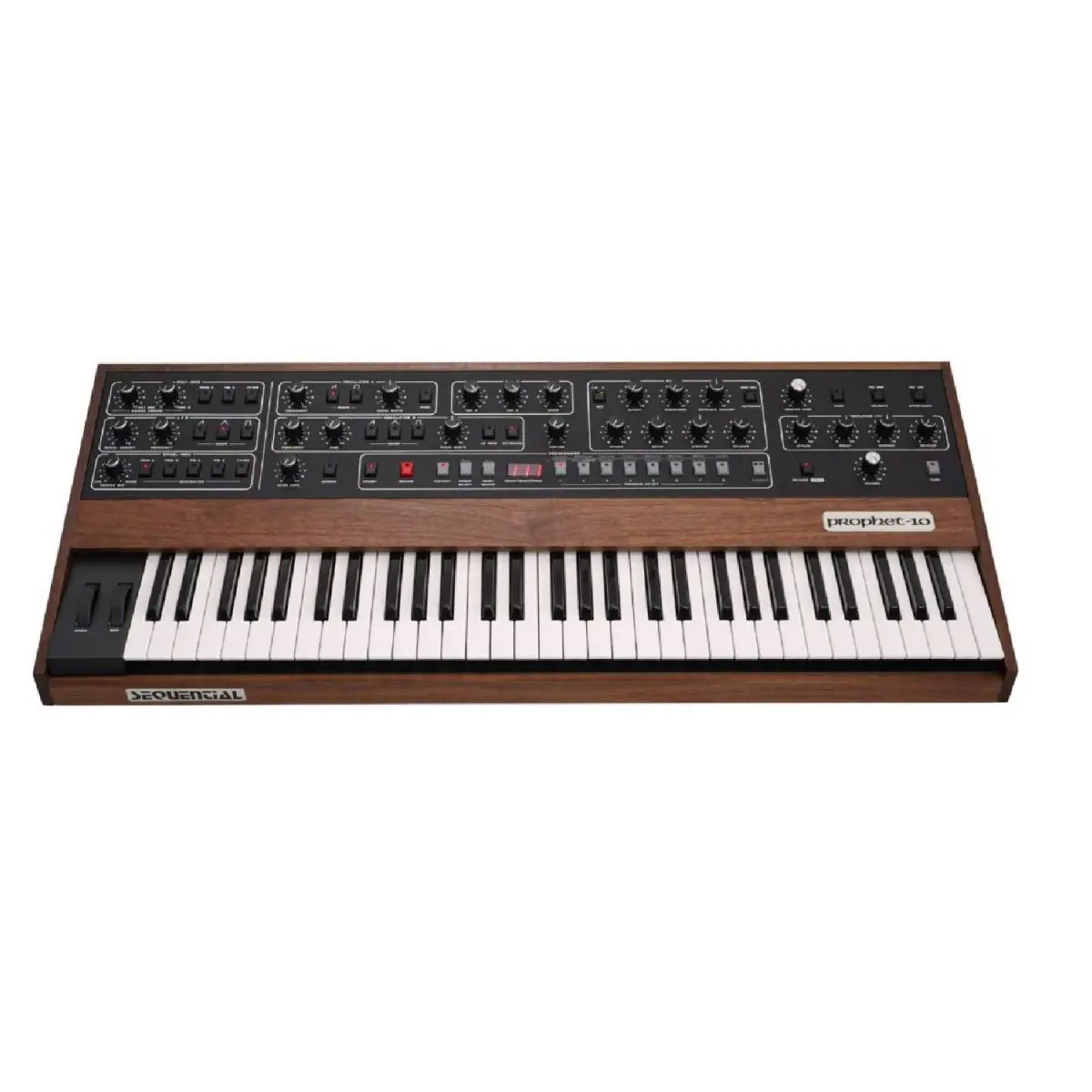
| |
OSCILLATORS | Two discrete VCOs per voice |
| Continuously variable wave shape (sawtooth and variable-width pulse, plus triangle on oscillator 2) per oscillator |
| Pulse width per oscillator |
| Hard sync: oscillator 1 syncs to oscillator 2 |
| Square wave sub-octave generator (oscillator 1) per voice |
| Low frequency mode (oscillator 2) |
| Keyboard tracking on/off (oscillator 2) |
| Oscillator detune amount for increased tuning instability, from subtle to extreme |
| |
MIXER | Oscillator 1 amount |
| Oscillator 1 sub-octave amount |
| Oscillator 2 amount |
| White noise amount |
| |
STATE-VARIABLE FILTER | Two-pole, resonant, filter per voice with low-pass, high-pass, band-pass, and notch functionality inspired by the original Oberheim SEM filter |
| Bi-polar filter envelope amount |
| Velocity modulation of envelope amount |
| Keyboard tracking: off, half, full |
| |
FILTER ENVELOPE | Four-stage (ADSR) envelope generator |
| Velocity modulation of envelope amount |
| |
AMPLIFIER ENVELOPE | Four-stage (ADSR) envelope generator |
| Velocity modulation of envelope amount |
| |
LOW FREQUENCY OSCILLATOR | Five wave shapes: sine, sawtooth, reverse sawtooth, square, and random (sample and hold) |
| Clock sync (internal or external MIDI clock) |
| Initial amount |
| Mod destinations: oscillator 1 frequency, oscillator 2 frequency, oscillator 1 and 2 pulse width, filter cutoff, filter mode, amp |
| |
X-MOD | Sources: filter envelope (bi-polar) and oscillator 2 (bi-polar) |
| Destinations: oscillator 1 frequency, oscillator 1 shape, oscillator 1 pulse width, filter cutoff, filter mode, normal to bandpass filter |
| |
AFTERTOUCH | Source: channel (mono) aftertouch with bi-polar amount |
| Destinations: oscillator 1 frequency, oscillator 2 frequency, LFO amount, amplifier envelope amount, filter envelope amount, filter mode |
| |
CLOCK | Master clock with tap tempo |
| BPM control and display |
| MIDI clock sync |
| |
ARPEGGIATOR | Selectable note value: 16th note, 8th note triplet, 8th note, dotted 8th note, quarter note |
| One, two, or three octave range |
| Up, down, up/down, random, and assign modes |
| |
SEQUENCER | Polyphonic step sequencer with up to 64 steps and rests |
| |
EFFECTS | Stereo analog distortion |
| Dual, 24-bit, 48 kHz digital effects, including: reverb (room, hall, plate, spring), delay (full bandwidth digital delay and emulated bucket brigade), chorus, flanger, phase shifters, and ring modulator |
| Delay sync |
| True bypass maintains fully analog signal path when digital effects are off |
| |
PERFORMANCE CONTROLS | Full-sized, semi-weighted, 4-octave keyboard with velocity and aftertouch |
| Backlit pitch and mod wheels |
| Spring-loaded pitch wheel with selectable range per program (1 to 12 semitones up and down) |
| Transpose controls for an 8-octave range |
| Hold switch latches held notes on |
| Polyphonic portamento |
| Unison (monophonic) mode with configurable voice count, from one to all six voices, chord memory, and key modes |
| Manual switch: when on, the front panel is live; what you see is what you hear |
| |
PATCH MEMORY | 500 user and 500 factory programs in 10 banks of 100 programs each |
| Direct program access, including single-button access to the current set of 10 programs |
| |
IN/OUT | Left/mono and right audio outputs (2 x 1/4” phone jack) |
| Headphone output (stereo, 1/4” phone jack) |
| MIDI in, out, and thru ports |
| USB for bidirectional MIDI communication |
| Filter cutoff expression pedal input |
| Volume expression pedal input |
| Sustain footswitch input |
| Sequencer start/stop footswitch input |
| |
POWER | IEC AC power inlet for internal power supply |
| Operates worldwide on voltages between 100 and 240 volts at 50 to 60 Hz; 30 watts maximum power consumption |
| |
PHYSICAL SPECS | 31.8” L x 12.7” W x 4.6″ H (80.7 cm x 32.3 cm x 11.7 cm) |
| 20 lbs (9.5 kg) |
| Walnut end panels |